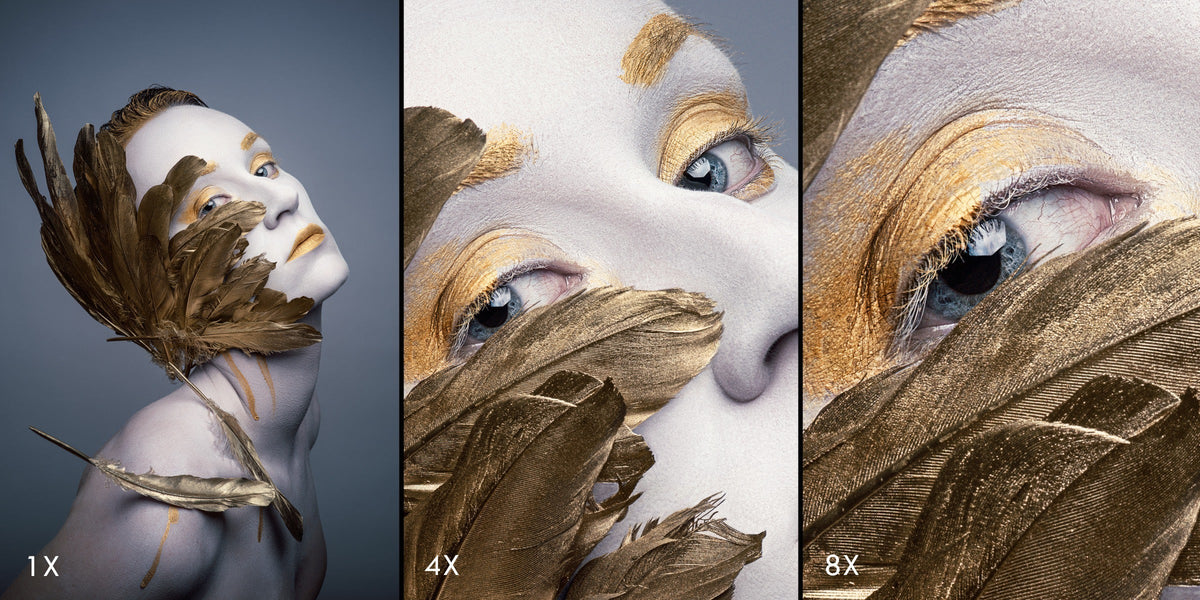
Fine art photography begins with a personal view of the world. Light, colour, form, and perspective give rise to a visual language that reaches beyond the individual subject. The camera supports this process by preserving the fine differences from which a work develops its presence: skin tones and shadows, quiet areas of colour, textures, and small details.
Hasselblad's digital medium format provides generous room for this. High resolution, 16-bit colour, and fine tonal gradations give image-makers the freedom to shape an image far beyond the moment the shutter is released—as a single image, a series, an artist's book, or a fine art print.
Fine Art Photography Begins with the Artistic Idea
Fine art photography is not tied to any specific subject. Portraits, landscapes, still lifes, documentary observations, and abstract works can all be part of the same artistic practice.
What matters is the intention behind the image. Light can separate a figure from the space around it or make it almost disappear into it. Colour can become a recurring motif within a series. A deliberately tight crop can be more important than showing the subject in full.
Technical quality expands the creative possibilities. Delicate shadows remain nuanced, subtle colours can be refined with precision, and fine textures retain their impact even after cropping or large-format output.
The result is a file that not only captures the moment, but also contains enough information to develop your personal signature consistently in further editing.

@Eva Zocher
Camera for Fine Art Photography as a Creative Tool
A camera for fine art photography must leave the idea behind the image enough freedom. Resolution, tonal range, and colour reproduction are particularly relevant because they determine how far an image can still be shaped after the shutter is released.
Resolution and Creative Freedom
High resolution does more than preserve detail. It keeps your options open.
A composition can be cropped more tightly later on. Perspective corrections can be made without the remaining image area quickly becoming a limiting factor. A work can be reframed for different forms of presentation.
At 100 megapixels, fine structures such as skin, hair, fabric, rock, or small object details remain visible even after extensive editing. This is especially valuable when a shot needs to work both as a complete image and a tighter crop.
Resolution is therefore not a technical end in itself. It gives artistic decisions more latitude.
Tonal Values and Dynamic Range
Many fine art works build their atmosphere in areas where the differences are small.
Dark clothing against a dark background, mist over a landscape, or a face in side light depends on a small number of decisive tonal gradations. If these differences are lost at capture, they can hardly be brought back convincingly later.
A wide dynamic range preserves more information between deep shadow and bright light. This allows the final contrast to be intentionally shaped during editing.
X2D II 100C offers a dynamic range of up to 15.3 stops at native ISO 50. CFV 100C reaches up to 15 stops. This reserve matters most where restraint, shadow detail, and fine transitions of light are part of the visual language.
Colour Depth and Natural Colour Reproduction
Fine art does not necessarily need intense colour. Often it is precisely the small differences that carry the image.
Two similar skin tones, a subtly warm grey, or a range of muted colours within a still life can matter more than high saturation.
A 16-bit workflow preserves finer gradations and provides greater scope for precise colour correction. Both X2D II 100C and CFV 100C work with 16-bit colour depth.
The Hasselblad Natural Colour Solution (HNCS) provides a consistent starting point for this. The natural rendering of skin, materials, and neutral areas can then be developed in whatever artistic direction you choose, without the look being predetermined by a strong, built-in colour character.

@Junsong He
Lenses and Visual Language in Fine Art Photography
A lens shapes the visual language of a project just as distinctly as the sensor. The angle of view, working distance, focus fall-off, and background determine how a subject appears in space.
For a series, the widest possible range of focal lengths is therefore not what matters most. What matters more is a look that can be deliberately repeated.
Restrained Perspectives
Moderate focal lengths create an angle of view that keeps the subject and its arrangement in the foreground.
XCD 2,5/55V is equivalent to approximately 43 mm in full-frame terms. This range suits contextual portraits, still lifes, interiors, and conceptual work where spatial effects should not dominate the actual message.
The perspective remains a result of the camera position. The focal length defines the framing, while the camera's distance and position shape the spatial relationship between the elements.
Subject Separation and Spatial Impact
A longer focal length creates a tighter frame and allows for a greater shooting distance.
XCD 2,5/90V corresponds to approximately 71 mm in full-frame terms, and its f/2.5 aperture offers additional control over the depth of field. This allows portraits, object studies, and pared-back still lifes to focus more closely on individual shapes or details.
The visual impact arises from the interplay of distance, aperture, background, and composition. The lens provides the framework within which these decisions become visible.
Preserving a Visual Language across a Series
Series feel more cohesive when certain visual qualities recur.
A similar angle of view, a familiar shooting distance, or a consistent rendering of sharpness can link images together, even when they are created in different places or at different times.
A deliberately limited choice of lenses supports this continuity. The camera becomes more familiar, decisions come faster, and you can focus your attention more fully on the image itself.
Camera as Part of the Creative Process
There is no single way of working in fine art photography. Some projects happen spontaneously, handheld. Others evolve over a longer period in the studio, on a tripod, or with a modular camera.
With X2D II 100C and 907X & CFV 100C, Hasselblad offers two different ways of working with the same core idea of digital medium format.
X2D II 100C for Freedom of Movement
X2D II 100C combines 100 megapixels, 16-bit colour, and a dynamic range of up to 15.3 stops with continuous autofocus, subject detection, and 5-axis image stabilisation of up to 10 stops.
This combination enables fine art projects that are not tied to a controlled set-up. Portraits can evolve from movement, landscapes can emerge while travelling, and personal projects can continue across changing locations and lighting conditions.
The high image quality remains paired with a direct, modern way of working. The camera supports rapid changes in the subject as well as carefully crafted individual images.
[cta: https://store-eu.hasselblad.com/products/x2d-ii-100c]
907X & CFV 100C for a Different Way of Seeing
907X & CFV 100C changes not only the technical configuration, but also the way an image is built.
The modular system enables a way of working with a tilting screen and lower camera positions. Looking down onto the camera can change your relationship with the subject and open up new perspectives on portraiture, still lifes, or space.
CFV 100C can also be connected to compatible Hasselblad V System cameras and technical cameras. This allows different camera concepts to become part of the same digital imaging workflow.
For fine art work, this opens up a particular kind of freedom: A modern medium-format file can be combined with a classic approach to composition or with deliberate movements of a technical camera.
X2D II 100C and 907X & CFV 100C therefore do not represent different levels of quality. They embody different ways of making images.
Black and White in Fine Art Photography
Monochrome photography shifts the focus from colour to brightness, texture, and form.
Areas that stand out clearly from one another in a colour image can end up with very similar shades of grey in black and white. Translating the original colour information thus becomes an essential part of the creative process.
A colour RAW file leaves this decision open. The individual colour channels can be weighted differently during conversion. A blue sky can appear darker, skin can stand out more brightly from the background, and vegetation can be differentiated by its original colour values.
16-bit data gives this process additional tonal latitude. In calm areas, mist, shadows, and soft grey gradients in particular, the finer gradation helps keep visible transitions clean.
Black and white is therefore not created by simply stripping away colour. It is an interpretation in its own right of the same image information.

@Hong Hua Shi
Colour and Tonal Values in Fine Art Photography
A personal visual language often emerges through recurring colours and tonal values.
A series can evolve over months or even years. Light, setting, and subject change, while certain neutral tones, skin tones, or contrast ratios are deliberately meant to belong together.
Consistent colour reproduction makes this process easier. It reduces the effort required to balance technical differences between individual shots, and gives creative editing a reliable starting point.
HNCS is designed for exactly this kind of continuity. The camera provides a natural rendering of the scene, while individual colour grading remains part of post-processing.
This allows colour to become the unifying element of a series, rather than having to be recreated from one shot to the next.
From Digital Image to Fine Art Print
In print, the image becomes an object.
Size, paper, surface, and the light in the room all change how colour, detail, and depth are perceived. A work on matt cotton paper has a different presence from the same image on a glossy baryta surface.
The source file therefore needs to contain enough information to support these decisions.
High resolution preserves fine structures in larger output. Tonal reserves help keep dark areas differentiated on paper too. A precise colour foundation makes it easier to adapt to different print media.
Preserving Colour from RAW to Print
A calibrated monitor provides a reliable reference point for brightness and colour. A defined colour space and suitable profiles then ensure that these decisions remain traceable on the way to output.
Soft proofing shows how a specific paper and printing process can alter colour and tonal values. Very dark areas, highly saturated colours, and fine neutral tones react visibly to the chosen medium.
Colour management does not restrict artistic interpretation. It makes it repeatable.
The Paper Becomes Part of the Work
A fine art print is more than just the physical output of a digital file.
The surface affects contrast, reflection, and texture. The paper white changes how bright areas of the image are perceived. The black level determines how deep shadows appear.
The choice of material is therefore part of shaping the final work.
Viewing distance also changes what resolution means. The larger a print is, and the closer you view it, the more clearly fine textures and subtle differences in the source file stand out.
There is no fixed megapixel threshold for fine art prints. Resolution becomes increasingly important with print size, cropping, viewing proximity, and richness of detail.
Hasselblad Cameras for Fine Art Photography
The choice between X2D II 100C and 907X & CFV 100C depends on how you want a work to come about.
The X2D II 100C combines the image quality of digital medium format with autofocus, image stabilisation, and an integrated mirrorless camera design. It suits artists who want to move freely between studio, portrait, landscape, travel, and spontaneous observation.
The 907X & CFV 100C puts modular image-making centre stage. Its design allows a different way of holding the camera and connects digital medium format with Hasselblad V System cameras and technical cameras. It is particularly well suited to projects in which the perspective, camera concept, and shooting process are deliberately made part of the work.
Both systems work with 100 megapixels, 16-bit colour, and Hasselblad Natural Colour Solution. The difference lies less in the final level of quality and more in the relationship between artist, camera, and subject.
[cta: https://store-eu.hasselblad.com/products/907x-cfv-100c]
Frequently Asked Questions about Fine Art Photography
What is meant by fine art photography?
Fine art photography grows out of an artistic concept or a personal interpretation. It can encompass portraits, landscapes, still lifes, documentary approaches, or abstraction. What matters is a deliberate visual language that carries through the capture, editing, and presentation of the work.
Which camera is suitable for fine art photography?
A camera with high resolution, a wide tonal range, and consistent colour reproduction offers a great deal of creative freedom. These qualities become particularly important with extensive editing, working in series, large-scale presentation, and subtle differences in colour or tonal values.
Is medium format a good choice for fine art photography?
Yes. Medium format gives you extra headroom for detail, tonal range, colour, and cropping. These qualities are particularly valuable when an image is heavily edited, presented as a large print, or developed consistently as part of a long-term series.
Does fine art photography have to be presented as a print?
No. Fine art photography can be presented as prints, artist's books, projections, digital installations, or in other formats. The print has a distinctive physical presence, but it is only one of several possible forms of the finished work.
What role does colour reproduction play in a fine art series?
Consistent colour reproduction creates a reliable foundation for images made in different places and over different periods of time. Recurring skin tones, neutral areas, or colour palettes can thus be more easily shaped into a coherent visual language.