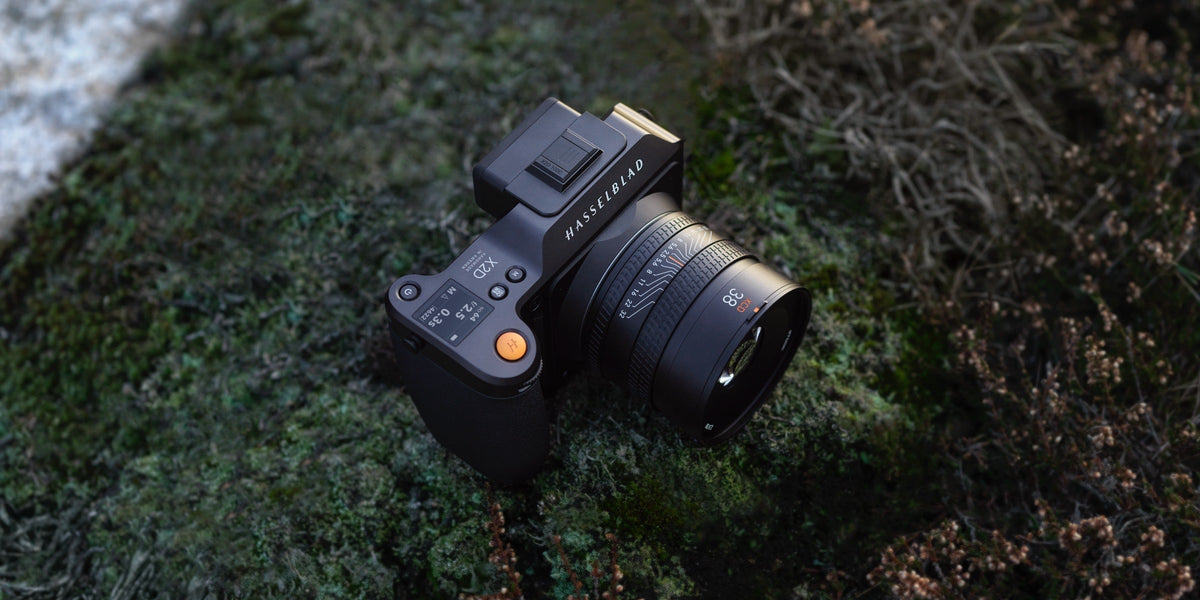
A medium-format camera uses an image area that is larger than the 35 mm full-frame format. The term does not refer to a single sensor size, but to a class of formats that includes analogue film cameras, digital system cameras, and modular digital backs.
In current Hasselblad medium-format cameras, the sensor measures 43.8 × 32.9 mm. Its surface area is roughly 67 per cent larger than that of a full-frame sensor measuring 36 × 24 mm. This allows subtle differences in colour, brightness, and material texture to be captured with high precision. The files also offer ample latitude for retouching, cropping, and large-format output.
What Does Medium Format Mean in Photography?
The term comes from analogue photography. Medium format sat between the smaller 35 mm small-format film and the larger sheet film formats of large-format photography.
This classification now also applies to digital cameras. Analogue medium-format systems expose 120 roll film in formats such as 6 × 4.5, 6 × 6, or 6 × 7 cm. Digital medium-format sensors vary in size depending on the manufacturer and system. Hasselblad uses a sensor area of 43.8 × 32.9 mm.
Medium format refers to the size of the recording medium, not the camera design. A medium-format system can take the form of an SLR camera, a mirrorless system camera, a view camera, or a modular combination of body and digital back.
|
Format class |
Typical image area |
Photographic focus |
|
Full frame |
36 × 24 mm |
Versatile systems and a wide choice of lenses |
|
Digital Hasselblad medium format |
43.8 × 32.9 mm |
Files rich in detail and nuanced tonal values |
|
Large format |
Various sheet film sizes |
Controlled, specialised workflows |
The larger format expands both the technical and creative possibilities. How noticeable this difference is in the final image also depends on the lens, lighting, focus, and overall photographic composition.
Medium Format vs. Full Frame
Medium format and full frame first and foremost differ in their sensor size. The larger recording area of medium format offers more scope for high resolution, nuanced brightness gradations, and extensive image editing.
Megapixel count and sensor size describe different characteristics. The number of megapixels indicates how many pixels the file is made up of. The sensor size refers to the physical area on which the light is captured. What matters most is how the sensor, lens, and image processing work together.
In practice, the difference becomes particularly apparent with demanding outputs. Medium-format files offer more resolution reserves when cropping, and can be retouched with precision and printed at large sizes without quickly losing their fine detail and tonal relationships.
Full-frame systems cover a very wide range of options, including compact travel cameras, video-focused models, and setups designed for high continuous shooting speeds and long focal lengths. Medium format puts much greater emphasis on the quality and flexibility of each individual image.
The choice depends on your subject, working style, and desired presentation. Both formats are capable of delivering professional results, but they prioritise different aspects.
Image Quality and Visual Impact in Medium Format
Resolution and Detail Rendition
The strength of a high-resolution medium-format file does not lie solely in maximum sharpness. It reveals itself in how fully an image is preserved, even after editing and enlargement.
Hair, textiles, skin, rock, or architectural surfaces can be distinguished with great precision. These details remain part of the overall composition rather than pushing themselves to the foreground as artificially accentuated sharpness.
The high level of detail opens up additional possibilities after the shot. A subject can be re-cropped to suit different layouts. Product shots can be carefully isolated, while portraits retain their natural texture even after extensive retouching. In landscape and architectural photography, the spatial structure remains clear and intelligible, even in large prints.
Resolution creates the freedom to shape and present an image later on.
Dynamic Range and Colour Reproduction
The distinctive quality of the medium format becomes especially apparent in subtle tonal transitions. Daylight can move across a face without the skin losing its natural colour. Different materials remain distinguishable in the shadows. Bright clouds retain their detail, while darker areas of the landscape continue to appear nuanced.
Accurate colour reproduction does not mean simply boosting colour saturation. What really matters is clearly separating similar colours from one another, while preserving their relationships within the image.
The Hasselblad Natural Colour Solution is designed to deliver natural, consistent colour reproduction. Combined with 16-bit colour information and a wide dynamic range, subtle gradations in colour and brightness can be carefully preserved even during post-production.
The technology remains discreet in its results. Light, surface, and atmosphere come into view.

@Junsong He
Depth of Field and Spatial Impact
For a comparable angle of view, medium format typically uses a longer actual focal length than full frame. With a similar composition and the same aperture, this can result in a shallower depth of field.
The subject in focus stands out clearly from the background, while the transition into softer areas of the image is gradual. Especially in portrait and still life photography, this can create a pronounced sense of depth.
This impression is created by several factors. Focal length, aperture, shooting distance, distance to the background, and lens design all work together. The perspective itself is primarily determined by the position of the camera.
The often-discussed medium-format look therefore cannot simply be reduced to stronger background blur. It arises from the interplay of fine detail, tonal gradation, optics, and composition.
Types of Medium-Format Cameras
Analogue Medium-Format Cameras
Analogue medium-format cameras usually use 120 roll film. Depending on the system, image formats such as 6 × 4.5, 6 × 6, or 6 × 7 cm are produced.
The film is a physical original whose character is shaped by its emulsion, development, and enlargement. If the image is to be processed further in digital form, it has to be scanned afterwards.
Many traditional medium-format systems are designed in a modular way. Film backs, viewfinders, and lenses can be combined to suit the task at hand. The act of composing on a focusing screen, the square image format, and the deliberate change of a film back all foster a highly focused way of working.
At Hasselblad, this modular principle has been central to the system philosophy for generations. Camera, optics, and recording format are regarded as a single, integrated tool.
Digital Medium-Format Cameras
In an integrated digital medium-format camera, the sensor and body form a single, fixed unit. Electronic viewfinder, autofocus, image stabilisation, and RAW processing are all integrated into a modern system.
Digital medium-format cameras can therefore be used in a wide range of situations. Depending on the body and lens, they are suited to studio, portrait, landscape, architecture, travel, and documentary-style photography.
A compact prime lens creates a nimble setup for shooting on the go. A zoom lens broadens the range of available angles of view. Autofocus and stabilisation support shots where the subject or the light is changing.
The larger imaging area remains the foundation. Modern camera technology makes its strengths accessible across a wider range of photographic scenarios.
Digital Backs and Modular Systems
In a modular digital system, the imaging unit is separate from the camera body. The digital back contains the sensor and can be combined with different camera configurations within a compatible system.
Hasselblad 907X & CFV 100C brings this principle into a modern digital workflow. CFV 100C can be connected to the 907X body, most Hasselblad film cameras from 1957 onwards, as well as suitable view cameras. Manual focusing is used with traditional film and view cameras.
This modular design preserves a familiar way of working. This includes composing at waist level, deliberately building up the system, and maintaining a direct relationship between the camera, subject, and image space.
The classic concept is not merely preserved, but carried forward as a contemporary photographic tool.
[cta: https://store-eu.hasselblad.com/de/products/907x-cfv-100c]
Structure and Workflow of a Medium-Format Camera
Sensor, lens, viewfinder, and processing together form the medium-format system.
The lens has to cover a larger image circle than a full-frame lens. Its design affects resolution all the way to the edges of the frame, the rendering of contrast and colour, as well as the transition between sharp and out-of-focus areas. The performance of the sensor can therefore only be assessed in combination with the lens being used.
The viewfinder also changes the way you work. An electronic viewfinder shows exposure and colour directly in real time. A tiltable display makes it easier to shoot from low angles. Classic waist-level viewfinders and focusing screens encourage a calmer composition with a stronger emphasis on image structure.
High-resolution RAW files require ample storage, reliable backup, and adequate computing power. In return, they provide extensive latitude for colour correction, retouching, cropping, and output.
Workflow planning already starts at the point of capture. Camera, lens, file format, and later presentation should all be carefully coordinated.
Application Areas for Medium-Format Cameras
Portrait, Fashion, and Editorial
In portrait and fashion photography, skin tones, hair, fabrics, and the way they blend into the background play a central role.
Medium-format files preserve these elements with exceptional precision, while providing ample flexibility for beauty retouching, editorial layouts, and varied crops. The image retains a cohesive, natural look even after extensive editing.
Hasselblad XCD lenses feature integrated leaf shutters. This allows flash to be synchronised across the range of shutter speeds supported by the lens. Especially when shooting outdoors, the balance between ambient light and added lighting can be controlled with great precision.
Landscape, Architecture, and Fine Art
Landscapes bring together delicate foreground detail, light, atmosphere, and a profound sense of depth.
Medium format can capture these layers in a highly nuanced way. Detail in clouds, tonal nuances in water, and structures in dark rock are all preserved within a cohesive image.
In architectural photography, the high resolution enables precise rendering of façades, materials, and geometric relationships. In fine art projects and exhibition prints, smooth tonal transitions and a consistent image surface become particularly evident.
The file carries enough detail to be appreciated even at large scale and from close viewing distances.
Product, Advertising, Travel, and Everyday Life
In product and advertising photography, material, edges, and colour must be rendered with precise control. A high-resolution medium-format file provides a robust foundation for this, and allows for different crops, retouching, and output formats.
With modern camera bodies and carefully chosen lenses, you can achieve the same image quality while shooting on the go. Medium format is now just as relevant for travel, street photography, and personal projects.
A lightweight prime lens supports a focused way of working. A zoom lens offers flexibility when you are working with changing subjects. How responsively the system performs is determined by the specific camera, autofocus, stabilisation, and chosen lens.
This means the format can be used in a wide range of situations, without losing its focus on colour, tonal values, and detail.

@Albrecht Voss
When Is a Medium-Format Camera Worth It?
Medium format reveals its true value when the additional image information becomes visible in the finished work, or can be put to use during production.
This applies to large-format prints, detailed commercial files, precise colour work, and shots that are extensively retouched or published in multiple formats. Personal projects can also benefit when light, materiality, and spatial calm are a fundamental part of the visual language.
The decision to buy a medium-format camera does not depend on professional status. What matters is how the photographs will be edited, viewed, and presented.
The system encompasses not only the camera body, but also lenses, focal lengths, storage, and post-processing. A carefully considered choice ensures that the camera's capabilities are genuinely integrated into your own workflow. Anyone planning to get started with medium format is best advised to clarify these points before buying.
Medium format is a precise tool for photographers who envision the final image as they shoot.
Modern Digital Medium Format in Practice
X2D II 100C combines the distinctive image qualities of medium format with a contemporary, mobile workflow.
Its 100 MP BSI CMOS sensor captures 16-bit colour and a dynamic range of up to 15.3 stops. HNCS HDR enables natural colour reproduction, as well as nuanced detail in highlights and shadows.
AF-C, subject detection, 425 phase-detection zones, and LiDAR expand your creative options with changing or moving subjects. The 5-axis image stabilisation with up to 10 stops of compensation in the centre of the frame supports longer shutter speeds when shooting handheld.
These features give the camera greater creative flexibility. The core visual language continues to be defined by natural colour, clear spatial relationships, and finely preserved detail.
In this way, X2D II 100C translates the precision of medium format into a modern mirrorless system.
[cta: https://store-eu.hasselblad.com/de/products/x2d-ii-100c]
Frequently Asked Questions about Medium-Format Cameras
Is 43.8 × 32.9 mm considered true medium format?
Yes. Digital medium format refers to a category of formats, not a single, fixed sensor size. A sensor measuring 43.8 × 32.9 mm has a significantly larger imaging area than 35 mm full frame, and is therefore classified as digital medium format.
What aspect ratios are common in medium-format photography?
Analogue systems use formats such as 6 × 4.5, 6 × 6, and 6 × 7. Digital Hasselblad sensors have an aspect ratio of approximately 4:3. Other aspect ratios such as 1:1, 4:5, or 16:9 can be set up via the live view before shooting, or created later by cropping.
Can older Hasselblad lenses be used on digital cameras?
Many lenses from the Hasselblad V and H systems can be used on current cameras with suitable adapters. The range of available functions depends on the lens, adapter, and camera body. With classic V system combinations, focusing is usually done manually.
Does a medium-format camera always need a tripod?
No. Modern medium-format cameras with image stabilisation can be used handheld in many situations. A tripod is still useful when you need long exposure times, repeatable framing, or maximum precision for landscape, architecture, and product photography.